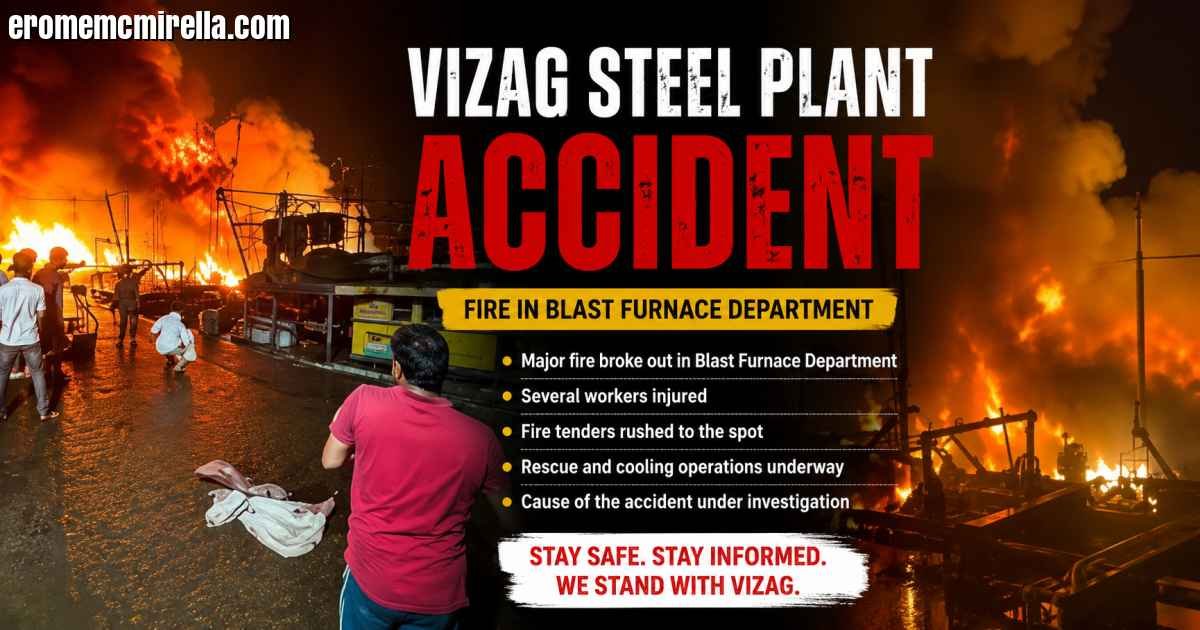
Vizag Steel Plant Accident: Complete Details, Cause, Death Toll, Investigation & Latest Updates
The Vizag Steel Plant accident of June 2026 has emerged as one of the most devastating industrial disasters in India in recent years. The tragedy occurred at Rashtriya Ispat Nigam Limited (RINL), popularly known as Vizag Steel Plant, where a catastrophic incident involving molten steel heated to approximately 1,500–1,600°C claimed multiple lives and left several workers with severe burn injuries.
The accident has reignited discussions about industrial safety, equipment maintenance, emergency response, and worker protection in heavy manufacturing industries. This comprehensive guide explains what happened, the confirmed death toll, the suspected causes, rescue efforts, government compensation, and the long-term impact of this tragedy.
What Happened in the Vizag Steel Plant Accident?
The Vizag Steel Plant accident occurred on Monday, June 8, 2026, at approximately 4:15 PM IST inside Steel Melt Shop-1 (SMS-1) at the Visakhapatnam Steel Plant.
According to official reports, workers were carrying out routine casting operations involving a ladle filled with molten steel. During the operation, a powerful explosion occurred, causing the ladle carrying the superheated metal to tip over, spilling an enormous quantity of molten steel directly onto workers positioned below.
The intense heat instantly created a massive fire, thick smoke, and panic throughout the steel melt shop. Emergency alarms were activated as rescue teams, plant officials, and the Central Industrial Security Force (CISF) fire wing rushed to the scene.
Visakhapatnam District Collector M. Abhishikth Kishore confirmed the incident and personally visited the accident site to supervise rescue operations. Images from the plant showed emergency personnel battling flames while attempting to rescue trapped workers.
The disaster quickly became national news due to the extreme nature of the accident and the high number of casualties.
Death Toll and Injured Workers: Latest Updates
The Vizag Steel Plant accident death toll increased over several days as critically injured workers succumbed to their burn injuries.
According to official updates:
- June 8, 2026: Multiple workers killed during the explosion.
- June 9, 2026: 8 workers confirmed dead and 6 others injured.
- June 10, 2026: Another critically injured worker died, raising the toll to 9.
- Latest reports, including updates from Deccan Chronicle, indicate that the death toll has reached 10 workers.
Many victims suffered 100% burn injuries, as molten steel at temperatures approaching 1,600°C leaves almost no chance of survival after direct exposure.
The injured workers were immediately shifted to the Vizag Steel Plant General Hospital and other specialized hospitals in Visakhapatnam, where doctors continue providing advanced treatment for severe burns and trauma.
The tragedy has deeply affected the families of the victims, many of whom were experienced workers performing routine industrial operations when the disaster occurred.
What Caused the Vizag Steel Plant Accident?
Preliminary investigations suggest that the accident resulted from a combination of mechanical failure and a sudden explosion inside the molten steel handling system.
Initial reports indicate that the overhead crane transporting the ladle experienced a critical failure. As the crane malfunctioned, the ladle containing molten steel became unstable and overturned, releasing the superheated metal onto workers below.
Investigators later identified another possible contributing factor.
According to early inquiry findings, trapped gases inside the vessel may have triggered a violent internal explosion. The blast appears to have destabilized the ladle, causing the crane assembly to lose control and spill molten steel across the work area.
Authorities are investigating several possible contributing factors, including:
- Crane malfunction or structural failure
- Pressure buildup from trapped gases
- Equipment maintenance issues
- Failure of established safety protocols
- Potential operational or human errors
The RINL management has launched a detailed investigation to determine the exact sequence of events and identify any technical or procedural lapses that contributed to the accident.
Rescue Operation, Government Response and Compensation
Immediately after the explosion, the plant’s emergency response systems were activated.
The CISF fire wing, plant emergency personnel, medical teams, and local authorities rushed to Steel Melt Shop-1 to rescue trapped workers and extinguish the fire.
Initially, rescue teams recovered several bodies before continuing search operations inside the affected section.
Senior officials quickly arrived at the accident site, including:
- Visakhapatnam District Collector M. Abhishikth Kishore
- Andhra Pradesh Home Minister Vangalapudi Anitha
- Visakhapatnam MP Mathukumilli Bharat
- Minister Nara Lokesh, who later visited hospitals and met victims’ families
The affected section of the steel plant was sealed while investigators began collecting evidence.
The Central and Andhra Pradesh governments announced multiple relief measures.
Union Steel Minister H. D. Kumaraswamy announced:
- ₹25 lakh ex-gratia for the family of each deceased worker
- Permanent employment for one eligible family member
- Educational support for the children of deceased workers
The Prime Minister’s Office also announced financial assistance from the Prime Minister’s National Relief Fund (PMNRF).
Both Prime Minister Narendra Modi and Andhra Pradesh Chief Minister N. Chandrababu Naidu expressed condolences and assured a thorough investigation into the tragedy.
Safety Concerns and the History of Vizag Steel Plant
The Visakhapatnam Steel Plant, operated by Rashtriya Ispat Nigam Limited (RINL), is among India’s largest integrated steel manufacturing facilities.
Established in 1971 and commissioned during the 1990s, the plant is widely recognized for producing high-quality steel and has long been one of India’s major public sector industrial enterprises.
Although the plant has experienced minor industrial incidents, including gas leaks and localized explosions over previous decades, officials acknowledge that an accident involving molten steel directly spilling onto workers is exceptionally rare.
The 2026 accident has renewed concerns regarding:
- Overhead crane maintenance
- Molten metal handling procedures
- Worker protective equipment
- Real-time monitoring systems
- Emergency evacuation planning
- Industrial safety compliance
Industry experts believe the disaster highlights the importance of strengthening safety systems in high-temperature manufacturing environments where even a small equipment failure can have catastrophic consequences.
Lessons from the Tragedy and Future Safety Measures
The Vizag Steel Plant accident 2026 has become a major wake-up call for India’s steel industry and other heavy manufacturing sectors.
Safety specialists recommend several important improvements to reduce the likelihood of similar incidents:
- Regular technical inspections of cranes, ladles, lifting systems, and gas pipelines.
- Installation of IoT-based monitoring systems capable of detecting abnormal temperatures, gas accumulation, and pressure changes before dangerous conditions develop.
- Mandatory use of advanced heat-resistant protective suits, helmets, face shields, and remote operating equipment for workers handling molten steel.
- Frequent emergency response drills and evacuation training for both permanent employees and contract workers.
- Independent safety audits conducted by organizations such as the Directorate General Factory Advice Service & Labour Institutes (DGFASLI) to ensure compliance with national industrial safety standards.
Many experts also recommend expanding automation in high-risk areas so that fewer workers are exposed directly to molten metal handling operations.
Final Verdict
The Vizag Steel Plant accident of June 8, 2026, stands as one of the most serious industrial disasters in Andhra Pradesh and India’s steel industry in recent years. What began as a routine casting operation inside Steel Melt Shop-1 quickly turned into a catastrophic event following an apparent crane failure and suspected gas explosion, leading to the deaths of 10 workers and serious injuries to several others.
While the governments of India and Andhra Pradesh have announced compensation packages, employment assistance, and educational support for affected families, the tragedy has also underscored the urgent need for stronger industrial safety practices, better equipment maintenance, and more advanced monitoring technologies.
As the official investigation continues, the focus remains on identifying the exact causes, ensuring accountability where necessary, and implementing reforms that can help prevent similar accidents in the future. The incident serves as a powerful reminder that worker safety must remain the highest priority in every heavy industrial operation, regardless of production demands or operational pressures.